Bioavailability by Design: Lipid Softgel Technology as a Commercial Rescue Path for Poorly Soluble, Low-Bioavailability Molecules

Solubility is broken.
The pipeline proves it.
What this whitepaper covers: Why solubility failure is the defining challenge of modern oral drug development — and how self-emulsifying softgel technology (SEDDS/SMEDDS/SNEDDS) unlocks bioavailability for BCS Class II & IV molecules.
Whitepaper Abstract:
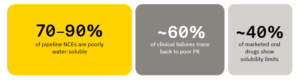
Modern drug discovery has a structural problem. As medicinal chemistry chases harder biological targets, molecules have grown larger, more lipophilic, and less soluble. Today, 70–90% of pipeline NCEs/NBEs are poorly water-soluble — and dissolving the molecule is only the first hurdle. Even when a drug dissolves, it must survive gut-wall efflux and first-pass hepatic metabolism before reaching systemic circulation.
Self-emulsifying lipid systems — SEDDS, SMEDDS, and SNEDDS — inside a soft gelatin capsule are the only oral dosage form that addresses all four absorption barriers at once. The drug arrives pre-dissolved; the matrix disperses spontaneously in the gut, bypassing dissolution entirely. The commercial proof spans cyclosporine, ritonavir, itraconazole, and six further marketed products.
OneSource integrates softgel formulation development, GMP clinical supply, commercial manufacturing, and lifecycle management under one quality system — removing the hand-offs that slow conventional CDMO partnerships.
This paper covers:
- why the solubility problem exists, is worsening, and what it costs in the clinic
- how self-emulsifying softgel technology works and how to match the right system to your molecule
- the OneSource engagement model from discovery through commercial launch