Building Better Combination Products by Engaging Device Development Earlier

What this article covers: Device development is not a downstream packaging decision. For injectable combination products, the delivery system can influence usability, dose accuracy, patient safety, manufacturability, regulatory strategy, and commercial readiness.
Article Abstract:
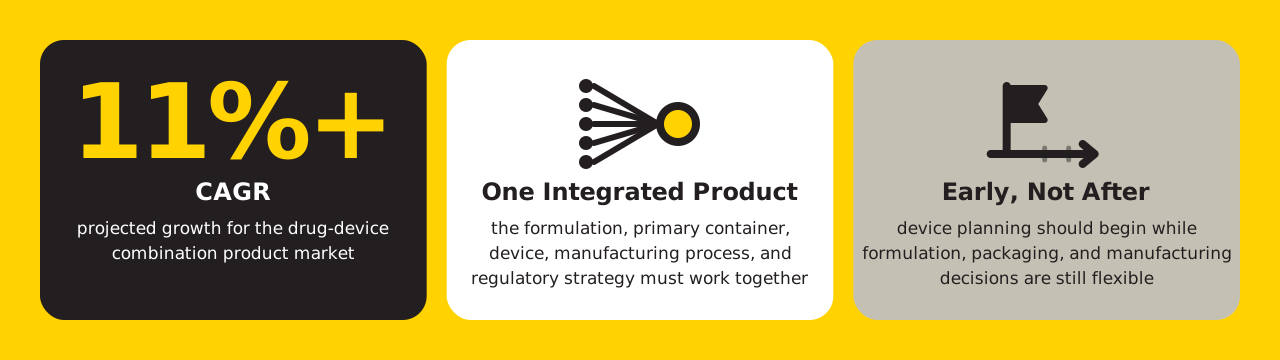
Device decisions are often deferred until formulation development is well underway. By then, choices related to viscosity, dose volume, storage conditions, primary packaging, and route of administration may limit available device options or require additional testing and development.
Device decisions are often deferred until formulation development is well underway. By then, choices related to viscosity, dose volume, storage conditions, primary packaging, and route of administration may limit available device options or require additional testing and development.
In this article, Loganathan S., AVP – Device Development and Packaging at OneSource, explains why drug and device workstreams should advance together. He also examines how early, cross-functional planning can help sponsors build combination products that are safe, usable, manufacturable, scalable, and ready for the market.
This Article Covers:
- How formulation, primary packaging, storage, and patient needs shape device requirements
- Why late device decisions can lead to repeated testing, redesign, and delayed milestones
- Where development risks emerge at the interfaces between drug, device, and manufacturing workstreams
- How established device platforms can accelerate development, and where product-specific evaluation remains essential
- How an integrated CDMO can connect drug substance, drug product, fill-finish, device assembly, testing, and regulatory support